I promised to report back on the korma I made for New Year's Eve. It came out wonderfully! Admittedly, it was very different from the cream/cardamom-based restaurant style of korma, but it was still creamy good and delightfully rich and complex in its taste. In the same bite, you could taste the pungent lamb, the pistachio and the yogurt. It was rather time-intensive, but it was worth it to have my dear husband insist I teach the cooks at the restaurant how to make it!
For New Year's Day I made a much simpler dish, a recipe from Madhur Jaffrey's "Invitation to Indian Cooking" involving black-eyed peas called lobhia. I used to make it often back when I was a vegan who wanted to make delicious food without a huge grocery bill. Some tomato, some black-eyed peas, some onion and some spices ... and the net result is YUM! I used to eat it with dry toasted whole-wheat bread instead of an Indian style of bread; this year, though, I made a dozen chappatis and we "dined in style" for the first night of 2008.
Saturday, January 12, 2008

Monday, December 31, 2007
As a korma simmers in the kitchen ...
One thing (among many) that I enjoy about having a day off from work is the opportunity it grants me to take the time to make something elaborate, something special, for dinner. Doesn't happen very often, but when it does I like to make something out of the ordinary. Tonight is one of those nights.
I'm sneaking in a quick post while tonight's dinner, lamb korma, simmers in the big nonstick pan for an hour.
I was lucky enough to find a good price for semi-boneless lamb (not a whole leg, but slices thereof) this afternoon at the supermarket, so I picked up a can of coconut milk and some cilantro (among many other items; I intend to be busy in the kitchen in the next 24 hours!). To me, lamb = Indian food, most likely korma (although I want to make a makhani, too), which = love. My husband and I both love Indian lamb recipes, so this would indeed be a special treat (I rarely bring meat home, and lamb is almost unheard of except for a holiday meal).
The recipe for korma that I chose, from "1,000 Indian Recipes," calls for 1/2 cup of cashew paste - soak cashews in hot water for 45 minutes, then blend in a blender with a few tablespoons of water until a paste emerges. Well ... I ran out of cashews but I had plenty of pistachios (my husband's next favorite nut) and sliced almonds, so I used them instead. And rather than using water, I poured in a bit of lite coconut milk. Naughty me!
I do my best to avoid substitutions or deviate from a given recipe. At least, not til I've made it so many times that I feel comfortable enough to try something different. So for the rest of the recipe I stayed within the lines: cardamom, whole dried red chiles, bay leaves, ground coriander and cumin, a dash of nutmeg and mace. The smell of minced onions, garlic and fresh ginger filled the house and drew my husband out from his office in the back with exclamations that boy, whatever that stuff is, it smells great! I put everything together and he can barely wait for the contents of the pan to gently boil down to a thickened sauce of spiced goodness.
If there are two spices that complement each other perfectly, it's coriander and cumin. One is gentle and sweet, a subtle backdrop with a supporting role to its sharper, more vivid companion. Pair them together, as in so many Indian recipes, and you have the makings of something wonderful, something you can never quite put your finger on but you know it when you find it: a luscious balancing act that dances on your palate like two divinely orchestrated dancers. Cooking with coriander and cumin is like reuniting lost lovers, and it brings a smile to my face every time.
Time to stir the pot - I'll let you know how dinner goes!
I'm sneaking in a quick post while tonight's dinner, lamb korma, simmers in the big nonstick pan for an hour.
I was lucky enough to find a good price for semi-boneless lamb (not a whole leg, but slices thereof) this afternoon at the supermarket, so I picked up a can of coconut milk and some cilantro (among many other items; I intend to be busy in the kitchen in the next 24 hours!). To me, lamb = Indian food, most likely korma (although I want to make a makhani, too), which = love. My husband and I both love Indian lamb recipes, so this would indeed be a special treat (I rarely bring meat home, and lamb is almost unheard of except for a holiday meal).
The recipe for korma that I chose, from "1,000 Indian Recipes," calls for 1/2 cup of cashew paste - soak cashews in hot water for 45 minutes, then blend in a blender with a few tablespoons of water until a paste emerges. Well ... I ran out of cashews but I had plenty of pistachios (my husband's next favorite nut) and sliced almonds, so I used them instead. And rather than using water, I poured in a bit of lite coconut milk. Naughty me!
I do my best to avoid substitutions or deviate from a given recipe. At least, not til I've made it so many times that I feel comfortable enough to try something different. So for the rest of the recipe I stayed within the lines: cardamom, whole dried red chiles, bay leaves, ground coriander and cumin, a dash of nutmeg and mace. The smell of minced onions, garlic and fresh ginger filled the house and drew my husband out from his office in the back with exclamations that boy, whatever that stuff is, it smells great! I put everything together and he can barely wait for the contents of the pan to gently boil down to a thickened sauce of spiced goodness.
If there are two spices that complement each other perfectly, it's coriander and cumin. One is gentle and sweet, a subtle backdrop with a supporting role to its sharper, more vivid companion. Pair them together, as in so many Indian recipes, and you have the makings of something wonderful, something you can never quite put your finger on but you know it when you find it: a luscious balancing act that dances on your palate like two divinely orchestrated dancers. Cooking with coriander and cumin is like reuniting lost lovers, and it brings a smile to my face every time.
Time to stir the pot - I'll let you know how dinner goes!
Monday, December 17, 2007
Dinners and desserts
This weekend was a blur of cooking and general puttering around in the kitchen. From beef stew and Italian wedding soup to lemon bars and whiskey balls, I kept the home fires (or oven, or stovetop) burning and the air redolent with the rich fragrance of shortbreads, fruit and wine. The two feet of snow that fell all day gave me all the more impetus to stay indoors and make delicious food happen.
Tonight I'll be whipping up a batch of butternut balls and sour cream cutout cookies.
Those who know me tend to be surprised that I crack open the oven door: I am not "the baker of the family," that would be my sister. But it's holiday time, and for me that's the one time a year I get out my recipe collection and start thinking about Christmas cookies.
I make the same cookies every year at holiday time, goodies that have meant "home" and "happiness" for thirty years. I don't need new recipes because they don't hold any memories for me.
I don't have any children with whom to share the tradition of chilling the sour cream cookie dough in the fridge overnight (and having to make another batch because little fingers were at the dough in the wee hours) or carefully handling the dough itself so that it behaves as it ought when it's rolled out and cut into Santas, trees, stars and bells. I don't have any children with whom to make new traditions. So it's just me and my own childhood in the kitchen as I roll the warm butternut balls in 10x sugar or make a quick batch of icing for the cutouts.
I remember my sister making doughnuts, cookies and countless other goodies with me when I was little. Usually my main role was holding the hand mixer's electrical cord to avoid the short in the wires (that lasted until my brother overheard "a little to the left ... now to the right a bit" one too many times and bought us a new mixer) or stirring a bowl of goodness (and getting to lick the spoon!). I have happy memories that I gently fold into each cookie that I will carry with me forever.
What memories do you have of holiday cookie-making time?
Tonight I'll be whipping up a batch of butternut balls and sour cream cutout cookies.
Those who know me tend to be surprised that I crack open the oven door: I am not "the baker of the family," that would be my sister. But it's holiday time, and for me that's the one time a year I get out my recipe collection and start thinking about Christmas cookies.
I make the same cookies every year at holiday time, goodies that have meant "home" and "happiness" for thirty years. I don't need new recipes because they don't hold any memories for me.
I don't have any children with whom to share the tradition of chilling the sour cream cookie dough in the fridge overnight (and having to make another batch because little fingers were at the dough in the wee hours) or carefully handling the dough itself so that it behaves as it ought when it's rolled out and cut into Santas, trees, stars and bells. I don't have any children with whom to make new traditions. So it's just me and my own childhood in the kitchen as I roll the warm butternut balls in 10x sugar or make a quick batch of icing for the cutouts.
I remember my sister making doughnuts, cookies and countless other goodies with me when I was little. Usually my main role was holding the hand mixer's electrical cord to avoid the short in the wires (that lasted until my brother overheard "a little to the left ... now to the right a bit" one too many times and bought us a new mixer) or stirring a bowl of goodness (and getting to lick the spoon!). I have happy memories that I gently fold into each cookie that I will carry with me forever.
What memories do you have of holiday cookie-making time?
Sunday, December 9, 2007
recipe: my linguine in clam sauce
My dear husband decided he was going to make linguine in clam sauce last week, using the recipe on the side of the linguine box. It came out ... okay ... except it was too salty, too thick and he used dried parsley. He swore that next time he had a craving fr the stuff, he'd get the recipe from me.
For anyone who'd like to try my recipe for linguine (in my family, "linguine" means only one thing: a white clam sauce), here it is. Again, as with mom's pasta e fagioli, quantities are estimated (are you a garlic lover? etc.).
Linguine (serves 1-2)
Half a box of linguine
olive oil
1 tablespoon butter
three or four big cloves of garlic, minced
two cans of clams, chopped or minced (doesn't matter; interchangeable)
2 tablespoons cornstarch
1/4 cup cold water
cayenne pepper
1/4 cup (est'd) fresh parsley, chopped
Cook the linguine according to the directions on the box.
Open the cans of clams with a can opener and let the lid settle to the tops of the clam bits. Set aside.
Coat the bottom of a saute pan with the olive oil and heat on medium-high. Melt the butter in the olive oil. When it's melted, add the garlic. Heat garlic until it's softened and juuuust beginning to brown (do not let it burn!). Immediately add the juice from the cans of clams, reserving the meats at the bottom. Bring all to a gentle boil.
In a small bowl, mix the cornstarch and water to make a thin, watery paste. Drizzle the cornstarch mixture into the clam sauce in the pan, stirring constantly, until the sauce begins to thicken. Turn off the heat and stir in the reserved clam meat. Sprinkle with cayenne pepper to taste and the parsley.
Drain the linguine when it's done and combine with the clam sauce.
Hope you like it - let me know how it turns out!
For anyone who'd like to try my recipe for linguine (in my family, "linguine" means only one thing: a white clam sauce), here it is. Again, as with mom's pasta e fagioli, quantities are estimated (are you a garlic lover? etc.).
Linguine (serves 1-2)
Half a box of linguine
olive oil
1 tablespoon butter
three or four big cloves of garlic, minced
two cans of clams, chopped or minced (doesn't matter; interchangeable)
2 tablespoons cornstarch
1/4 cup cold water
cayenne pepper
1/4 cup (est'd) fresh parsley, chopped
Cook the linguine according to the directions on the box.
Open the cans of clams with a can opener and let the lid settle to the tops of the clam bits. Set aside.
Coat the bottom of a saute pan with the olive oil and heat on medium-high. Melt the butter in the olive oil. When it's melted, add the garlic. Heat garlic until it's softened and juuuust beginning to brown (do not let it burn!). Immediately add the juice from the cans of clams, reserving the meats at the bottom. Bring all to a gentle boil.
In a small bowl, mix the cornstarch and water to make a thin, watery paste. Drizzle the cornstarch mixture into the clam sauce in the pan, stirring constantly, until the sauce begins to thicken. Turn off the heat and stir in the reserved clam meat. Sprinkle with cayenne pepper to taste and the parsley.
Drain the linguine when it's done and combine with the clam sauce.
Hope you like it - let me know how it turns out!
Saturday, December 8, 2007
experiments with plants
I'll admit it, I'm not much of a plant person. I don't know much about gardening - just enough to produce usable produce - and I know even less about house plants. But that doesn't always stop me from trying new tricks!
My mom came over a few weeks ago and taught me to snip off parts of my long-languishing begonia plant and place the cut ends in water to encourage the leggy stalks to create roots in the water. I looked at that and figured, why not try that with other plants?
For my first experiment, I took a 4-inch stalk of spearmint from a plant that I'd put in the kitchen windowbox at the beginning of this past spring, and placed it in a small, clean jelly jar filled with water. The results? Two weeks later, there are no roots, but there are new leaves!
Puzzling, but I'll keep an eye on it to see what it does next.
And the begonia snips? Three weeks or so later, and still no roots - but they look perfectly healthy so I'll keep them going for as long as they keep up the good work.
My mom came over a few weeks ago and taught me to snip off parts of my long-languishing begonia plant and place the cut ends in water to encourage the leggy stalks to create roots in the water. I looked at that and figured, why not try that with other plants?
For my first experiment, I took a 4-inch stalk of spearmint from a plant that I'd put in the kitchen windowbox at the beginning of this past spring, and placed it in a small, clean jelly jar filled with water. The results? Two weeks later, there are no roots, but there are new leaves!
Puzzling, but I'll keep an eye on it to see what it does next.
And the begonia snips? Three weeks or so later, and still no roots - but they look perfectly healthy so I'll keep them going for as long as they keep up the good work.
Monday, December 3, 2007
back to my first culinary love
The long holiday weekend gave me a chance to catch up on some recreational cooking. Since I work anywhere from 8 to 11 hours a day with a nice, healthy commute, I haven't really had opportunity to whip up anything that really spoke to my spirit in a good long time.
What really inspired me was a cookbook I picked up at Borders on the day before Thanksgiving: "1,000 Indian Recipes" by Neelam Batra. Just glancing through the book made me see that here were a vast number of recipes just waiting to be made. I couldn't put it down at the bookstore, and kept leafing through it when I got it home. I simply had to try it out!
My kitchen is full of Indian spices, since I used to cook almost exclusively Indian, so I didn't have to invest a lot in preparing to return to my first culinary love. Some of the ingredients were new to me, such as boondi (tiny drops of besan, or chickpea flour, that is lightly fried and sold commercially) and ajwain. But I live in a metropolitan area that can support multiple Asian grocery stores within a mile or so of each other, so I was lucky enough to simply drive down the boulevard and stop at a couple of shops along the way.
Within an hour, my kitchen began to once again take on familiar aromas. South Indian chicken, with its use of unsweetened shredded coconut as well as coconut milk, took on a lovely fragrance with the use of shredded curry leaves. Fresh curry leaves, I found out, have an odor that's somewhat off-putting at first ... but when simmered in a curry base they come into their own and transform the dish into something delightful.
This weekend I plan to have more Indian-inspired fun, making chapatis and naan to go with my curries ... maybe picking up some more papadums ... and making some paneer - possibly paneer pakora or saag paneer - for the coming week. Yum!
What really inspired me was a cookbook I picked up at Borders on the day before Thanksgiving: "1,000 Indian Recipes" by Neelam Batra. Just glancing through the book made me see that here were a vast number of recipes just waiting to be made. I couldn't put it down at the bookstore, and kept leafing through it when I got it home. I simply had to try it out!
My kitchen is full of Indian spices, since I used to cook almost exclusively Indian, so I didn't have to invest a lot in preparing to return to my first culinary love. Some of the ingredients were new to me, such as boondi (tiny drops of besan, or chickpea flour, that is lightly fried and sold commercially) and ajwain. But I live in a metropolitan area that can support multiple Asian grocery stores within a mile or so of each other, so I was lucky enough to simply drive down the boulevard and stop at a couple of shops along the way.
Within an hour, my kitchen began to once again take on familiar aromas. South Indian chicken, with its use of unsweetened shredded coconut as well as coconut milk, took on a lovely fragrance with the use of shredded curry leaves. Fresh curry leaves, I found out, have an odor that's somewhat off-putting at first ... but when simmered in a curry base they come into their own and transform the dish into something delightful.
This weekend I plan to have more Indian-inspired fun, making chapatis and naan to go with my curries ... maybe picking up some more papadums ... and making some paneer - possibly paneer pakora or saag paneer - for the coming week. Yum!
Wednesday, November 21, 2007
"Coming Home to Eat"
I started reading "Coming Home to Eat: The Pleasures and Politics of Local Foods" by Gary Paul Nabhan this afternoon. Just reading the preface and introduction to this handy-sized book has me eagerly awaiting the rest of his story!
Nabhan is of Lebanese ancestry and he tells of traveling from his home in southern Arizona to Lebanon to visit with aunts and uncles and assorted relatives. Along the way he finds himself at an exclusive Middle Eastern casino, where he realizes the exotic foods - Caspian Sea caviar and the like - and even the building materials come from outside of the country. Such sharp contrast to the meal with which his family welcomes him to Lebanon: foods produced or grown, and certainly prepared, locally. That contrast sticks with him through his first night in that faraway land, and starts him thinking of what it means, what it takes, to bring the food wealth of other nations to one's table.
Book's off to a lovely start - I think I'll enjoy the rest of the trip into Nabhan's world.
Nabhan is of Lebanese ancestry and he tells of traveling from his home in southern Arizona to Lebanon to visit with aunts and uncles and assorted relatives. Along the way he finds himself at an exclusive Middle Eastern casino, where he realizes the exotic foods - Caspian Sea caviar and the like - and even the building materials come from outside of the country. Such sharp contrast to the meal with which his family welcomes him to Lebanon: foods produced or grown, and certainly prepared, locally. That contrast sticks with him through his first night in that faraway land, and starts him thinking of what it means, what it takes, to bring the food wealth of other nations to one's table.
Book's off to a lovely start - I think I'll enjoy the rest of the trip into Nabhan's world.
Sunday, November 4, 2007
A visit to Vince's Imports
I stopped by Vince's Imports in North Syracuse this afternoon to see what kind of imports Vince has. Vince specializes in Italian imports ... lots of different sauces, biscotti, loads of cheeses, a fascinating selection of fresh pastas and sauces made in-house, pasta makers and espresso machines (electric and, apparently, stovetop).
I was intrigued by the selection of spaetzle makers; what were they doing among all the Italian stuff? But seeing them reminded me of how my stepkids (who are part-German) used to enjoy making spaetzle from scratch and squishing the dough through the holes in a semi-melted plastic colander. I almost got one of the spaetzle makers, having almost convinced myself that I would be making spaetzle soon ... then I walked away quickly: I know better.
Checking out the jars of olives in brine, salt capers and giardenara, not to mention the vast array of smoked, pickled and dried meats and cheeses, I was reminded that what we think of as Italian cuisine is actually a relatively modern selection of dishes derived from a time when there were limited methods of preserving foods. It's actually kind of exciting to walk into a specialty shop like Vince's and realize that you're looking at more than 2,000 years of civilization dressed up in modern clothes. All those hard salamis have an ancient history behind them.
As my father once told me when I was still very small, "You don't like olives? There is no way you can be Italian if you don't like olives." Eschewing olives meant turning my nose up at his culture, his people, his heritage, his very identity. To him, we truly are what we eat, and in a fundamental way he understood that our foods define us. If he were still alive he'd be proud to know that (thanks in large part to the Wegmans Mediterranean bar) as an adult I've developed quite a fondness for olives.
I was intrigued by the selection of spaetzle makers; what were they doing among all the Italian stuff? But seeing them reminded me of how my stepkids (who are part-German) used to enjoy making spaetzle from scratch and squishing the dough through the holes in a semi-melted plastic colander. I almost got one of the spaetzle makers, having almost convinced myself that I would be making spaetzle soon ... then I walked away quickly: I know better.
Checking out the jars of olives in brine, salt capers and giardenara, not to mention the vast array of smoked, pickled and dried meats and cheeses, I was reminded that what we think of as Italian cuisine is actually a relatively modern selection of dishes derived from a time when there were limited methods of preserving foods. It's actually kind of exciting to walk into a specialty shop like Vince's and realize that you're looking at more than 2,000 years of civilization dressed up in modern clothes. All those hard salamis have an ancient history behind them.
As my father once told me when I was still very small, "You don't like olives? There is no way you can be Italian if you don't like olives." Eschewing olives meant turning my nose up at his culture, his people, his heritage, his very identity. To him, we truly are what we eat, and in a fundamental way he understood that our foods define us. If he were still alive he'd be proud to know that (thanks in large part to the Wegmans Mediterranean bar) as an adult I've developed quite a fondness for olives.
Wednesday, October 31, 2007
pictures of my garden on Halloween
A couple of people have asked to see pictures of my garden, so this morning I brought out the camera before I went off to work and snapped a few quick shots. I can't say it's all that impressive, but here goes!

Here's the broccoli I wrote about. I've about given up on it.

Here's my rosemary bush. It grew nicely this year ... unlike the basil, which really wasn't all that photogenic this morning. To the right are (some weeds and) the strawberry plants that produced exactly one misshapen, bitter berry before abandoning the concept altogether and moving on to other pursuits, such as sending tendrils out on a reconnaissance mission to the failed experiment known as my cucumber plants. Maybe next year will be better. Or maybe I'm supposed to be doing soil amendments or something, I don't know.

Loads and loads of green tomatoes that undoubtedly will never actually turn orange, let alone red. I'm not sure I'm very excited about eating fried tomatoes - I've heard about it but never tried it, but I tend to avoid fried foods on general principle (and the recommendation of my gall bladder). Maybe there's another way of preparing green tomatoes ... I just need to do some research. If I find anything I'll post about it - or if anyone has any ideas please share them!

The Greek oregano did very well this year! Nice, big leaves and such a marvelous fragrance. I surprised myself this year with how much fresh oregano my recipes wanted: I found myself plucking the tender, soft leaves several times over the summer, including the stuffed eggplant dish I brought to the first Eat Local potluck supper.

The "macro" feature on my camera focused on the green leafy background, but you can still make out the unmistakable shapes of little proto-peppers. I still can't believe that those plants are still trying to make peppers months after the season allegedly ended!
Here's the broccoli I wrote about. I've about given up on it.
Here's my rosemary bush. It grew nicely this year ... unlike the basil, which really wasn't all that photogenic this morning. To the right are (some weeds and) the strawberry plants that produced exactly one misshapen, bitter berry before abandoning the concept altogether and moving on to other pursuits, such as sending tendrils out on a reconnaissance mission to the failed experiment known as my cucumber plants. Maybe next year will be better. Or maybe I'm supposed to be doing soil amendments or something, I don't know.
Loads and loads of green tomatoes that undoubtedly will never actually turn orange, let alone red. I'm not sure I'm very excited about eating fried tomatoes - I've heard about it but never tried it, but I tend to avoid fried foods on general principle (and the recommendation of my gall bladder). Maybe there's another way of preparing green tomatoes ... I just need to do some research. If I find anything I'll post about it - or if anyone has any ideas please share them!
The Greek oregano did very well this year! Nice, big leaves and such a marvelous fragrance. I surprised myself this year with how much fresh oregano my recipes wanted: I found myself plucking the tender, soft leaves several times over the summer, including the stuffed eggplant dish I brought to the first Eat Local potluck supper.
The "macro" feature on my camera focused on the green leafy background, but you can still make out the unmistakable shapes of little proto-peppers. I still can't believe that those plants are still trying to make peppers months after the season allegedly ended!
Saturday, October 27, 2007
At the supper, in spirit anyway ...
Tonight was indeed the night of the next Syracuse Eat Local supper, and I had every intention of attending (especially since it was taking place so close to my house) ... I even went out to the Regional Market and the Syracuse Real Food Coop to make sure I had everything I needed ... but by the time I got home from the memorial service that was held this afternoon (a friend from church passed away the other day), I knew I was just drained and wouldn't be able to attend. :(
However, I still had all my ingredients and so I put together a lovely winter greens and potato casserole, courtesy of a recipe I found in the Jan-Feb 2004 Cooking Light magazine. Finding the ingredients was an amazingly simple task, thanks to the hard work of the folks at Stone's Throw Farm, home of some gorgeous organic veggies. They had pretty much everything I needed - a pound of kale, a pound of mustard greens and two pounds or so of some incredible red potatoes. The only thing on my list that they didn't have was locally made cheese, which I found at SRFC.
(I'll be adding a photo to this post when I'm done, showing you what I mean by "gorgeous" - I've fallen in love with their red potatoes, which are actually pink right through the center and seem to be far less starchy than any other potato I've ever sliced. They're not like those, well, the typical little red potatoes you see in the supermarket ... they're kind of elongated, not round, and a bit knobbly but not really ... well, you'll see.)
So even though I can't be at the supper tonight, I'm there in spirit with my potato casserole cooking in the oven.
Here's a bowl of fresh kale next to these luscious potatoes:

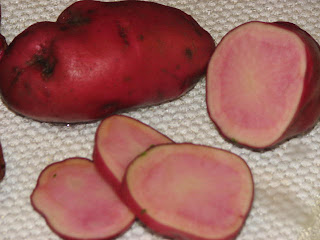
And this is a sliced potato, up close and personal.
However, I still had all my ingredients and so I put together a lovely winter greens and potato casserole, courtesy of a recipe I found in the Jan-Feb 2004 Cooking Light magazine. Finding the ingredients was an amazingly simple task, thanks to the hard work of the folks at Stone's Throw Farm, home of some gorgeous organic veggies. They had pretty much everything I needed - a pound of kale, a pound of mustard greens and two pounds or so of some incredible red potatoes. The only thing on my list that they didn't have was locally made cheese, which I found at SRFC.
(I'll be adding a photo to this post when I'm done, showing you what I mean by "gorgeous" - I've fallen in love with their red potatoes, which are actually pink right through the center and seem to be far less starchy than any other potato I've ever sliced. They're not like those, well, the typical little red potatoes you see in the supermarket ... they're kind of elongated, not round, and a bit knobbly but not really ... well, you'll see.)
So even though I can't be at the supper tonight, I'm there in spirit with my potato casserole cooking in the oven.
Here's a bowl of fresh kale next to these luscious potatoes:


And this is a sliced potato, up close and personal.
Sunday, October 21, 2007
I looked in the garden this afternoon and found one viable red tomato and dozens of big fat green ones. Most of the tomato plants have begun dying back, including the ones that overshadowed the bell pepper plants - which are now producing little peppers as if it were springtime. I can't blame them for being confused - today's weather was glorious, mid-70s and totally cloudless. Most of the month has been similar. Gotta hand it to the pepper plants: they managed to produce one or two nice big peppers before the monster tomatoes took over. Now they're trying again! That's the spirit!
I'm starting to think about autumn and what to do with my garden. I'm wondering about what to do with the herbs. Specifically, what do I do with the Greek oregano and the nice, tall rosemary bush? it would be great if I could transplant them into pots in my house and enjoy them all winter long.
One thing I very much want to do this fall is roast some vegetables, drizzling them with olive oil and sprinkling with chopped fresh rosemary before going in the oven. My sister does this and the results are incredible! I've never done it, and I have the rosemary, so I want to give it a go. Anyone ever roast veggies this way? How'd it go for you?
I'm starting to think about autumn and what to do with my garden. I'm wondering about what to do with the herbs. Specifically, what do I do with the Greek oregano and the nice, tall rosemary bush? it would be great if I could transplant them into pots in my house and enjoy them all winter long.
One thing I very much want to do this fall is roast some vegetables, drizzling them with olive oil and sprinkling with chopped fresh rosemary before going in the oven. My sister does this and the results are incredible! I've never done it, and I have the rosemary, so I want to give it a go. Anyone ever roast veggies this way? How'd it go for you?
Monday, October 15, 2007
radishes and squashes
One fun thing that came out of the Eat Local Challenge is that it gave me the gift of a regular habit: visiting the Regional Market every Saturday and discovering the farmers that quickly became my favorites. As I visit from week to week, I'm able to make observations that would otherwise escape me.
The folks from Central Square - can't remember their farm's name, but I can picture their stall - produced, hands-down, THE biggest and mildest radishes I've ever tasted. I'm talking about radishes the size of ... well, I dunno - but they were huge. Same with their carrots. They said the secret was their good soil. Well, vive la soil! I stop by every Saturday to see what they have. Unfortunately, they were all out of radishes by the time I arrived yesterday. Hopefully they'll have some next week, although I don't know - is it the end of radish season?
I'm seeing more and more squashes of various types. (I'm talking about winter squashes like Hubbard, not the ubiquitous yellow summer squash or even zucchini.)
I confess I don't really know what to do with squashes. All I can think is to take my biggest knife and carve the things up into manageable pieces, then steam until tender and scoop off the tasty bits for mashing into paste. (One exception: spaghetti squash. What a neat vegetable that is!)
Farmers at the market are bringing more and more squashes as the weeks go by, leading me to believe that now would be a good time to learn more about squash, collect some recipes and start experimenting!
The folks from Central Square - can't remember their farm's name, but I can picture their stall - produced, hands-down, THE biggest and mildest radishes I've ever tasted. I'm talking about radishes the size of ... well, I dunno - but they were huge. Same with their carrots. They said the secret was their good soil. Well, vive la soil! I stop by every Saturday to see what they have. Unfortunately, they were all out of radishes by the time I arrived yesterday. Hopefully they'll have some next week, although I don't know - is it the end of radish season?
I'm seeing more and more squashes of various types. (I'm talking about winter squashes like Hubbard, not the ubiquitous yellow summer squash or even zucchini.)
I confess I don't really know what to do with squashes. All I can think is to take my biggest knife and carve the things up into manageable pieces, then steam until tender and scoop off the tasty bits for mashing into paste. (One exception: spaghetti squash. What a neat vegetable that is!)
Farmers at the market are bringing more and more squashes as the weeks go by, leading me to believe that now would be a good time to learn more about squash, collect some recipes and start experimenting!
Sunday, October 14, 2007
Tiny green crowns
This year I planted broccoli in my garden - the first time I've ever tried. I was amazed by how well it grew!
I mean that literally. You see, I knew nothing about broccoli when I put the plant in the ground.
First thing that happened was nice, big, healthy-looking crowns came up from among the broad, rubbery leaves. Wonderful, I said, and picked them. My mac and cheese was never so tasty as when I knew I'd grown at least some part of it myself.
I thought that would be the end of my broccoli plants. Boy, was I wrong.
Next thing I knew, all sorts of little tiny broccoli heads popped up in the crooks between the main stalks and the leaves! I had more than a dozen new heads come up in the space of a week or so. None of them was even close to the size of the broccoli crowns you see in supermarkets, so I left them alone. I assumed they'd keep on growing and would become something superhumanly huge on their own.
All that waiting resulted in a transmogrification of my plants from good-natured little florets to wild masses of exuberant yellow flowers and ecstatic bumblebees. Yikes, I said, and hastily picked the few non-flowery shoots.
More little broccoli heads popped up. I tried keeping pace but after I while I admitted defeat - seemingly overnight, those cute little florets became foot-tall yellow stalks of sunshine that proceeded to create what looked like tiny bean pods.
My garden never did achieve full cruciferous glory after producing those first few good-sized crowns. But the veggies were tasty ... and the plants became so pretty. I'll tell myself I learned something - namely, find more friends and relatives who like broccoli - and try again next year.
I mean that literally. You see, I knew nothing about broccoli when I put the plant in the ground.
First thing that happened was nice, big, healthy-looking crowns came up from among the broad, rubbery leaves. Wonderful, I said, and picked them. My mac and cheese was never so tasty as when I knew I'd grown at least some part of it myself.
I thought that would be the end of my broccoli plants. Boy, was I wrong.
Next thing I knew, all sorts of little tiny broccoli heads popped up in the crooks between the main stalks and the leaves! I had more than a dozen new heads come up in the space of a week or so. None of them was even close to the size of the broccoli crowns you see in supermarkets, so I left them alone. I assumed they'd keep on growing and would become something superhumanly huge on their own.
All that waiting resulted in a transmogrification of my plants from good-natured little florets to wild masses of exuberant yellow flowers and ecstatic bumblebees. Yikes, I said, and hastily picked the few non-flowery shoots.
More little broccoli heads popped up. I tried keeping pace but after I while I admitted defeat - seemingly overnight, those cute little florets became foot-tall yellow stalks of sunshine that proceeded to create what looked like tiny bean pods.
My garden never did achieve full cruciferous glory after producing those first few good-sized crowns. But the veggies were tasty ... and the plants became so pretty. I'll tell myself I learned something - namely, find more friends and relatives who like broccoli - and try again next year.
Sunday, September 30, 2007
Last night's potluck supper get-together was great! Nine individuals from varying backgrounds came together over delicious food and drink - almost entirely locally grown/produced ingredients, including the wine. We were architects, farmers, journalists, pastors and retail workers, but we had one thing in common: a concern for the future of our world in general, our community in particular, expressed through a desire to eat locally, sustainably. It was a wonderful way to wrap up the Eat Local challenge.
I learned a lot just from the supper. I brought a vegetable vinaigrette salad that included corn kernels. The recipe called for frozen kernels, but why buy frozen when I can get sweet, succulent corn on the cob, fresh-picked from the farm, and get my own? That's where the learning came in: I learned that it's incredibly easy to cut kernels off the cob. I don't know where I got the idea that it was difficult - just a good, sharp blade and a sturdy hand, and the kernels practically jumped off the cob. Two cobs produced 2.5 cups of kernels, exactly what was called for in the recipe.
I learned that locally produced, pastured-fed meat is quite expensive compared with the commercial offerings at the local supermarket. Ground beef is some $5 a pound or so; or was that the steaks? Either way, it was quite beyond my food budget. Some day I would like to be able to support local beef producers, but that day is far off right now. I was able to pick up a dozen large, local eggs for $1.80; not the lowest price but good enough. With some bleu cheese and a mild cheddar, that was it for animal products, for me.
I learned that there is far more locally produced foods than I'd ever consciously realized, judging from the feast we enjoyed last night. Wine from one of the many Finger Lakes wineries provided a joyful libation; tossed greens topped with goat cheese; long, fat green beans in a pesto sauce; vegetable-stuffed eggplant; etc. My vegetable salad called for a sweetener, so I used a dab of locally produced raw honey that I'd bought at the Regional Market that morning.
Best of all, I learned that there are more of us who are interested in food - from source to table - than I imagined. Around here, it's easy to get the impression that you're the only one who's into a given subject. Then you gradually hear through about others, and eventually you learn through the grapevine that there are all these other people quietly forming their own small groups of like minds ... and I think that's what's happening now. Several folks at the table last night named at least one person who'd wanted to attend but couldn't.
And so we agreed - we'd meet up for another local-food potluck supper on the fourth Saturday of the month. And we were pretty sure we'd be a larger crowd next time. I hope so, because the more the merrier!
I learned a lot just from the supper. I brought a vegetable vinaigrette salad that included corn kernels. The recipe called for frozen kernels, but why buy frozen when I can get sweet, succulent corn on the cob, fresh-picked from the farm, and get my own? That's where the learning came in: I learned that it's incredibly easy to cut kernels off the cob. I don't know where I got the idea that it was difficult - just a good, sharp blade and a sturdy hand, and the kernels practically jumped off the cob. Two cobs produced 2.5 cups of kernels, exactly what was called for in the recipe.
I learned that locally produced, pastured-fed meat is quite expensive compared with the commercial offerings at the local supermarket. Ground beef is some $5 a pound or so; or was that the steaks? Either way, it was quite beyond my food budget. Some day I would like to be able to support local beef producers, but that day is far off right now. I was able to pick up a dozen large, local eggs for $1.80; not the lowest price but good enough. With some bleu cheese and a mild cheddar, that was it for animal products, for me.
I learned that there is far more locally produced foods than I'd ever consciously realized, judging from the feast we enjoyed last night. Wine from one of the many Finger Lakes wineries provided a joyful libation; tossed greens topped with goat cheese; long, fat green beans in a pesto sauce; vegetable-stuffed eggplant; etc. My vegetable salad called for a sweetener, so I used a dab of locally produced raw honey that I'd bought at the Regional Market that morning.
Best of all, I learned that there are more of us who are interested in food - from source to table - than I imagined. Around here, it's easy to get the impression that you're the only one who's into a given subject. Then you gradually hear through about others, and eventually you learn through the grapevine that there are all these other people quietly forming their own small groups of like minds ... and I think that's what's happening now. Several folks at the table last night named at least one person who'd wanted to attend but couldn't.
And so we agreed - we'd meet up for another local-food potluck supper on the fourth Saturday of the month. And we were pretty sure we'd be a larger crowd next time. I hope so, because the more the merrier!
Friday, September 28, 2007
Local news article on eating locally
Just wanted to share the news that Hamilton College here in central New York has taken part in the Eat Local challenge by means of a picnic Sept. 25. Good for them!
Story's at the Utica Observer-Dispatch: here.
Story's at the Utica Observer-Dispatch: here.
Wednesday, September 26, 2007
eating locally - challenging in twists and turns
It's amazing how it's easy in some ways to eat locally, and so hard in others.
When I was at my stepson's house visiting with his family (home of the new baby!), the first thing his wife did was ask me if I wanted some tomatoes from the garden of one of her clients. Of course I said yes - I would never turn away a gift of food. In exchange, I gave her half a dozen ears of corn I'd picked up at the Regional Market. Supper that night included corn on the cob.
(Perhaps tomatoes are runners-up in the competition for most prolific vegetable, second to the ubiquitous zucchini? A co-worker brought in at least a dozen cheerfully red tomatoes with a Post-It note reading, "help yourself." She told me she was making a fresh batch of spaghetti sauce every week by pureeing her tomatoes, 18 at a time, and adding canned tomato sauce and spices. Frankly, I would love to see her garden.)
Later, at my sister's house, she had a bag full of rhubarb from a friend's garden. It was a mere fraction of her original quality of leafy goodness because she used the rest of the rhubarb to make some of her incredible strawberry-rhubarb pie, complete with lattice top. She also whipped up several loaves of, yes, zucchini bread.
Every day for lunch, I have a sandwich with locally grown lettuce and Sundance Farms' delicious organic heirloom tomatoes (or tomatoes from my own garden). I wish more of my sandwich ingredients were local. And that brings me to the finer points of what challenged me about eating locally.
But eating locally can mean giving up on some things, depending on one's level of strictness in regards to compliance. Rice, for example, isn't local to my area (that I know of). Wheat might be ... or at least, there's a local flour mill that produces outstanding flours and mixes. Then there's the bakery at the Regional Market that sells scrumptious loaves of artisan breads but their flour is made from wheat grown in Quebec. My husband (who is not participating in the Eat Local challenge in any way) came home with several varieties of (non-local) sandwich meats, but I can't find local sandwich bread. Is there a local pasta? Coffee isn't local - but there's a local roaster or two.
I debated all these things this month. How local did I feel comfortable going? Did I perceive the challenge to be about buying food that was 100 percent locally produced or buying from small, local grocers/producers? At what point on the map did "local" end? How much driving (ie., adding greenhouse gases to the environment) was I willing to do in order to get to where the local food was, and couldn't I just ride my bike and get some exercise in on top of that? Should I give up making curries because nobody around here grows the key ingredients in garam masala?
These are all valid questions that not everyone would answer the same way. Some would absolutely say if it isn't from around here, it won't make the cut. Others would commit to replacing as much "imported" foods with locally produced items as they could fit into their budget and busy schedules. To me, the important part has been being more aware of the benefits of eating locally - financially, culturally, environmentally.
It's been a exciting month (I know, it's not over yet!) as far as being more cognizant of where my food comes from and where my grocery dollars are going.
When I was at my stepson's house visiting with his family (home of the new baby!), the first thing his wife did was ask me if I wanted some tomatoes from the garden of one of her clients. Of course I said yes - I would never turn away a gift of food. In exchange, I gave her half a dozen ears of corn I'd picked up at the Regional Market. Supper that night included corn on the cob.
(Perhaps tomatoes are runners-up in the competition for most prolific vegetable, second to the ubiquitous zucchini? A co-worker brought in at least a dozen cheerfully red tomatoes with a Post-It note reading, "help yourself." She told me she was making a fresh batch of spaghetti sauce every week by pureeing her tomatoes, 18 at a time, and adding canned tomato sauce and spices. Frankly, I would love to see her garden.)
Later, at my sister's house, she had a bag full of rhubarb from a friend's garden. It was a mere fraction of her original quality of leafy goodness because she used the rest of the rhubarb to make some of her incredible strawberry-rhubarb pie, complete with lattice top. She also whipped up several loaves of, yes, zucchini bread.
Every day for lunch, I have a sandwich with locally grown lettuce and Sundance Farms' delicious organic heirloom tomatoes (or tomatoes from my own garden). I wish more of my sandwich ingredients were local. And that brings me to the finer points of what challenged me about eating locally.
But eating locally can mean giving up on some things, depending on one's level of strictness in regards to compliance. Rice, for example, isn't local to my area (that I know of). Wheat might be ... or at least, there's a local flour mill that produces outstanding flours and mixes. Then there's the bakery at the Regional Market that sells scrumptious loaves of artisan breads but their flour is made from wheat grown in Quebec. My husband (who is not participating in the Eat Local challenge in any way) came home with several varieties of (non-local) sandwich meats, but I can't find local sandwich bread. Is there a local pasta? Coffee isn't local - but there's a local roaster or two.
I debated all these things this month. How local did I feel comfortable going? Did I perceive the challenge to be about buying food that was 100 percent locally produced or buying from small, local grocers/producers? At what point on the map did "local" end? How much driving (ie., adding greenhouse gases to the environment) was I willing to do in order to get to where the local food was, and couldn't I just ride my bike and get some exercise in on top of that? Should I give up making curries because nobody around here grows the key ingredients in garam masala?
These are all valid questions that not everyone would answer the same way. Some would absolutely say if it isn't from around here, it won't make the cut. Others would commit to replacing as much "imported" foods with locally produced items as they could fit into their budget and busy schedules. To me, the important part has been being more aware of the benefits of eating locally - financially, culturally, environmentally.
It's been a exciting month (I know, it's not over yet!) as far as being more cognizant of where my food comes from and where my grocery dollars are going.
Tuesday, September 18, 2007
local Eat Local potluck!
For anyone in central New York who might be interested - there will be an Eat Local potluck supper on Saturday, Sept. 29 at 6 p.m. in the University/Westcott area of Syracuse.
Some more info:
Sound like fun? Wanna come? Please e-mail Jennifer for specific location and directions: JLBASKER [at] SYR [dot] edu. See you there!
Some more info:
What: Eat Local Potluck
When: Saturday, Sept 29th at 6:00 PM
Where: University/Westcott Neighborhood
In the spirit of the Eat Local Challenge, please bring a dish that is made from food grown as local as possible. This will give everyone a chance to share some of their favorite local food sources. Also, if possible, bring copies of the recipe so we can recreate your delicious dish on our own. We'll have a chance to talk about the joys and challenges of eating locally in Syracuse and, perhaps, lay a foundation for an Eat Local Dinner Club.
Sound like fun? Wanna come? Please e-mail Jennifer for specific location and directions: JLBASKER [at] SYR [dot] edu. See you there!
A baby is born!
Please pardon my absence for the next couple of days as I help welcome home my grandson Damien, who was born this afternoon! Six pounds, 11 oz. and equipped with an excellent pair of lungs. Mom and Dad are doing just fine and go home with their new bundle of joy Thursday morning. Tomorrow night after work I'm headed to their house to make sure everything is tidy for their arrival, and Thursday after work I'll be stopping by to make sure they have everything they need. So I'll be back Friday!
Monday, September 17, 2007
Low-carbon footprints
It stopped raining long enough to take a look at my garden yesterday - and thankfully it wasn't too much of a disaster!
Three big, red tomatoes ... a handful of grape tomatoes (which came up from last year's crop: we didn't plant any this year because we don't care for the taste) and a random cherry tomato. A dozen itty-bitty shoots of broccoli ... some healthy basil, oregano, and rosemary. With the addition of some locally grown lettuces, radishes and scallion that I brought home from the market, I have a good start on a salad whose total carbon footprint might be less than my own.
That's one thing that bugs me: Commuting to my day job means burning two gallons of gas a day. I'm not thrilled about that, but there isn't much I can do about it until a job in my field opens up closer to home (not likely). The least I can do for our air quality, the environment and the climate is to do my best to buy foods that don't have to travel thousands of miles to get to me. Bonus if they're organic/sustainably grown in addition to being local.
Next thing I do is pick up some locally grown root vegetables at the market this Saturday and roast them in my oven with some fresh rosemary and extra-virgin olive oil! I wonder if the local bus service goes from my neighborhood to the market on Saturday mornings ...
Three big, red tomatoes ... a handful of grape tomatoes (which came up from last year's crop: we didn't plant any this year because we don't care for the taste) and a random cherry tomato. A dozen itty-bitty shoots of broccoli ... some healthy basil, oregano, and rosemary. With the addition of some locally grown lettuces, radishes and scallion that I brought home from the market, I have a good start on a salad whose total carbon footprint might be less than my own.
That's one thing that bugs me: Commuting to my day job means burning two gallons of gas a day. I'm not thrilled about that, but there isn't much I can do about it until a job in my field opens up closer to home (not likely). The least I can do for our air quality, the environment and the climate is to do my best to buy foods that don't have to travel thousands of miles to get to me. Bonus if they're organic/sustainably grown in addition to being local.
Next thing I do is pick up some locally grown root vegetables at the market this Saturday and roast them in my oven with some fresh rosemary and extra-virgin olive oil! I wonder if the local bus service goes from my neighborhood to the market on Saturday mornings ...
Sunday, September 16, 2007
Local food for seniors
A cold and rainy Saturday couldn't stop me from spending some time down at the Regional Market in Syracuse. What a delight to see the incredible produce! And at such fabulous prices. A bundle of scallions - crisp, dark green tapers at least a foot long - cost a mere $1. A dozen ears of fresh-picked butter and sugar corn for $2. Red bell peppers, each the size of my doubled fists, for 50 cents each.
My favorite yogurt producer, Wake Robin Farm, was there! I discovered they sell milk, too. I saw Sundance Farm, too, from Marcellus, which was nice - I like to see stuff from my roots. Their heirloom tomatoes were irresistable!
But the best thing I found at the market wasn't food. It was opportunity.
Inside one of the sheds was a little table at which sat three women with a boatload of pamphlets from the New York State Senior Farmers Market Program. What's this, I asked? Turns out it's a program for people age 60 and over whose income is a certain level (it may also be open to families in the WIC program). What happens is once a person is accepted into the program, they are given a certain number of checks in the amount of $2 each that can be used at certain farmers' stands at local regional markets up to Nov. 15. The checks can only be used to buy locally grown foods (not honey, flowers, ornamental pumpkins or gourds, etc.).
I was delighted to learn of this program because so often, older people just don't have the money to buy good, wholesome food. And even though the program's been around for some 10 years or so, not everyone knows about this program - I was pretty sure my mom didn't. So I grabbed a pamphlet for her and brought it home to share with her later.
My favorite yogurt producer, Wake Robin Farm, was there! I discovered they sell milk, too. I saw Sundance Farm, too, from Marcellus, which was nice - I like to see stuff from my roots. Their heirloom tomatoes were irresistable!
But the best thing I found at the market wasn't food. It was opportunity.
Inside one of the sheds was a little table at which sat three women with a boatload of pamphlets from the New York State Senior Farmers Market Program. What's this, I asked? Turns out it's a program for people age 60 and over whose income is a certain level (it may also be open to families in the WIC program). What happens is once a person is accepted into the program, they are given a certain number of checks in the amount of $2 each that can be used at certain farmers' stands at local regional markets up to Nov. 15. The checks can only be used to buy locally grown foods (not honey, flowers, ornamental pumpkins or gourds, etc.).
I was delighted to learn of this program because so often, older people just don't have the money to buy good, wholesome food. And even though the program's been around for some 10 years or so, not everyone knows about this program - I was pretty sure my mom didn't. So I grabbed a pamphlet for her and brought it home to share with her later.
Subscribe to:
Comments (Atom)